
Three Games I Enjoyed this Summer
One of the best things about being involved in the board game hobby is that there is always something new to discover.
Even after years of playing games, I still find myself sitting down at the table with something I know very little about and thinking, “Okay, this is pretty cool.”
Lately, three games in particular have been getting my attention: Entropy, Orloj, and Moon Colony Bloodbath.
They are very different games, but they all have something in common: they gave me that feeling that I always hope to get from a new game. The feeling of wanting to play again as soon as the game is over.
Which, honestly, is probably the most dangerous feeling a board gamer can have. One minute you're enjoying a game and the next you're wondering where you're going to put the new copy you're inevitably going to buy.
Entropy
Entropy, designed by Tommaso Battista, Simone Luciani, and Nestore Mangone, with artwork by Piotr Orleański and Zbigniew Umgelter, was probably the biggest surprise for me.
There are a lot of games that look interesting when you first see them on the table, but Entropy immediately grabbed my attention. There is a lot going on, there are plenty of interesting decisions to make, and the game has that satisfying combination of planning ahead while still having to adapt to what everyone else is doing.
You're building solar systems, developing life, managing resources, and trying to figure out how all of those pieces are going to work together. It has that wonderful feeling of slowly turning something that starts out relatively simple into something much more complicated and interesting.
What I particularly enjoy is that Entropy doesn't feel like you're simply following a predetermined path toward victory. You're constantly making decisions about what you want to accomplish and figuring out how to make the pieces in front of you work together.
And, of course, there is something really satisfying about watching your plans start to come together.
Then somebody does something that completely messes them up.
That's board gaming.
The more I've played Entropy, the more I appreciate how much is going on underneath the surface. It rewards paying attention and thinking ahead, but it doesn't feel like you need to solve the entire game before you start playing.
That's a sweet spot I really enjoy.
It gives you enough to think about that you feel clever when things work, but not so much that you need to schedule a second appointment with yourself just to figure out your next turn.
Orloj
Orloj: The Prague Astronomical Clock, designed by Abraham Sanchez Hermida and Paloma J. Pascual, with artwork by Jesús Fuentes and Amelia Sales, is another game that has really stood out to me recently.
First, the theme and production do a lot to draw you into the game. You're working around the famous astronomical clock in Prague, and the mechanisms of the game do a nice job of making the theme feel like more than just something pasted onto a board.
But what really keeps bringing me back is the puzzle.
There are several things you want to accomplish, and getting one thing often means giving something else up. You're constantly looking at the board and thinking about what you can do now, what you need to set up for later, and what everyone else might be trying to accomplish.
Those are the games I tend to enjoy the most.
I like having a plan.
I like when the game makes me change that plan.
And I really like when I think I've found a clever solution only to realize that I should have thought about something three turns earlier.
Orloj has given me plenty of those moments.
There's also something particularly appropriate about playing a game centered around a giant astronomical clock and realizing that you have somehow spent ten minutes staring at it trying to figure out what to do next.
Apparently, time really does fly when you're overthinking worker placement.
Moon Colony Bloodbath
And then there is Moon Colony Bloodbath.
The title alone is enough to get my attention.
Designed by Donald X. Vaccarino, with artwork by Franz Vohwinkel, Moon Colony Bloodbath takes the familiar idea of building a colony and asks an important question:
What if everything went horribly, horribly wrong?
The answer, apparently, is this game.
You're trying to survive and build your colony while dealing with the problems that come with, well... being on a moon colony where apparently everything wants to kill you. The shared deck constantly creates new situations, some helpful and some very much not helpful. The game can shift quickly from “I've got a great plan” to “Why is everyone dead?”
And somehow, that's fun.
What I enjoy about Moon Colony Bloodbath is the tension.
You can make a plan, but the game has a way of throwing problems at you that force you to reconsider what you're doing. Sometimes the best decision isn't necessarily the one that gives you the biggest immediate benefit. Sometimes it's simply the decision that keeps your situation from getting dramatically worse.
And that's fun.
There is something really satisfying about games that create stories naturally through their mechanics. You finish a game and immediately start talking about the things that happened.
“Remember when that happened?”
“Yeah, and then you did THAT.”
“Yeah, that was probably my fault.”
Those are the games that tend to stick with me.
Moon Colony Bloodbath does this particularly well because the game seems almost designed to create those stories. Your colony isn't simply a collection of cards and numbers. It's a collection of disasters you somehow survived.
Or didn't.
So What Do These Games Have in Common?
Looking at these three games together, they are actually a pretty good representation of what I've been enjoying in the hobby lately.
I want games that give me interesting decisions.
I want games that don't completely fall apart when something unexpected happens.
I want games that reward having a plan without punishing me for changing it.
And, most importantly, I want games that give me a reason to sit down and play them again.
I'm not necessarily looking for the biggest game, the most complicated game, or the game with the most components.
Sometimes I just want something that makes me look at the table at the end of the game and think:
“Okay. Let's do that again.”
That's probably the best compliment I can give a game.
Because there are plenty of games that I can appreciate.
There are games I can admire.
There are games I can understand why other people love.
But the games that make me immediately want to play again?
Those are the ones that stay on the table.
And right now, Entropy, Orloj, and Moon Colony Bloodbath are three games giving me exactly that feeling.
Now if you'll excuse me, I have apparently developed a very serious problem involving astronomical clocks, lunar disasters, and the complete collapse of ecosystems.
So, basically, a normal week in board gaming.
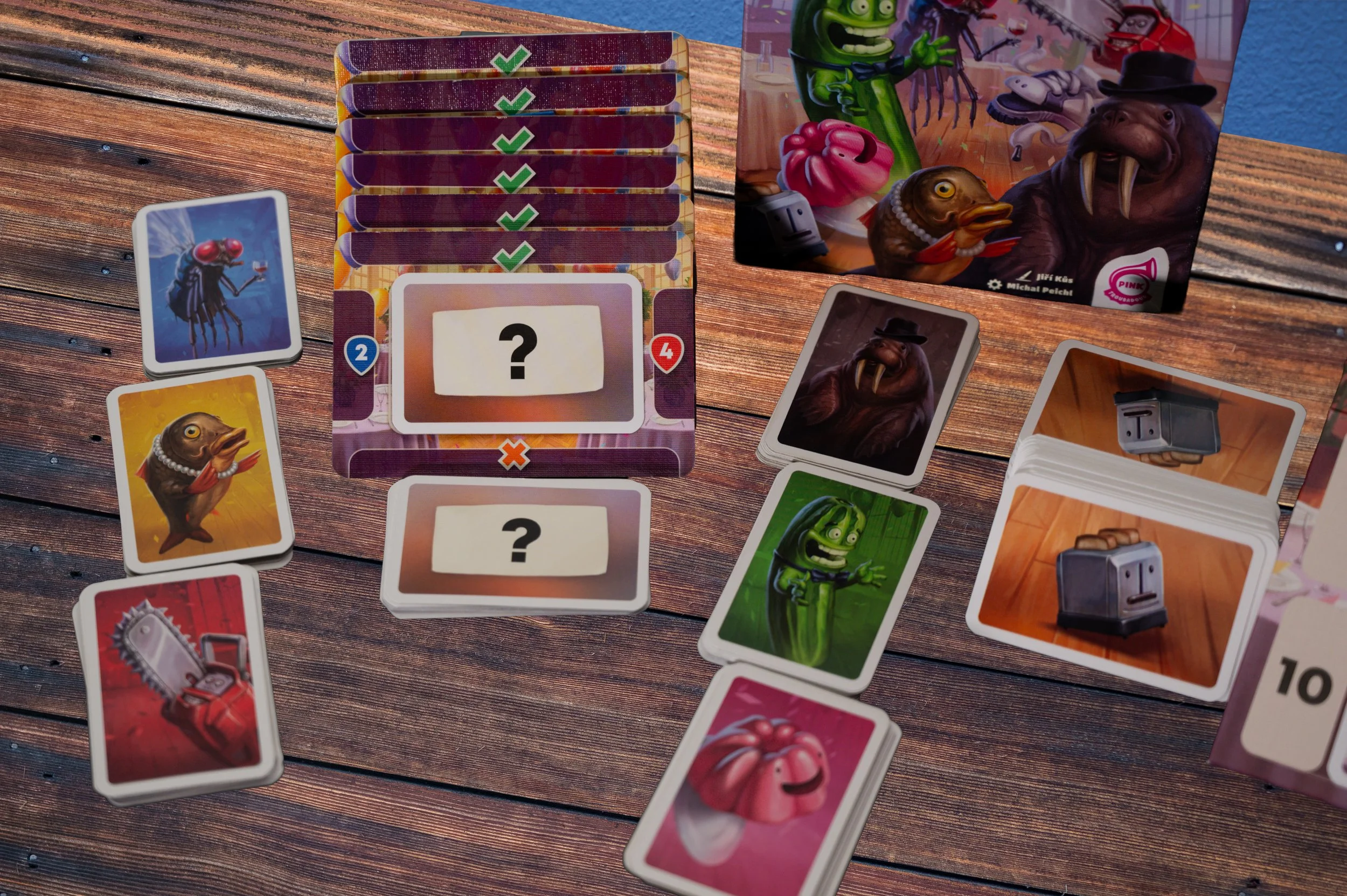
Loony Clues
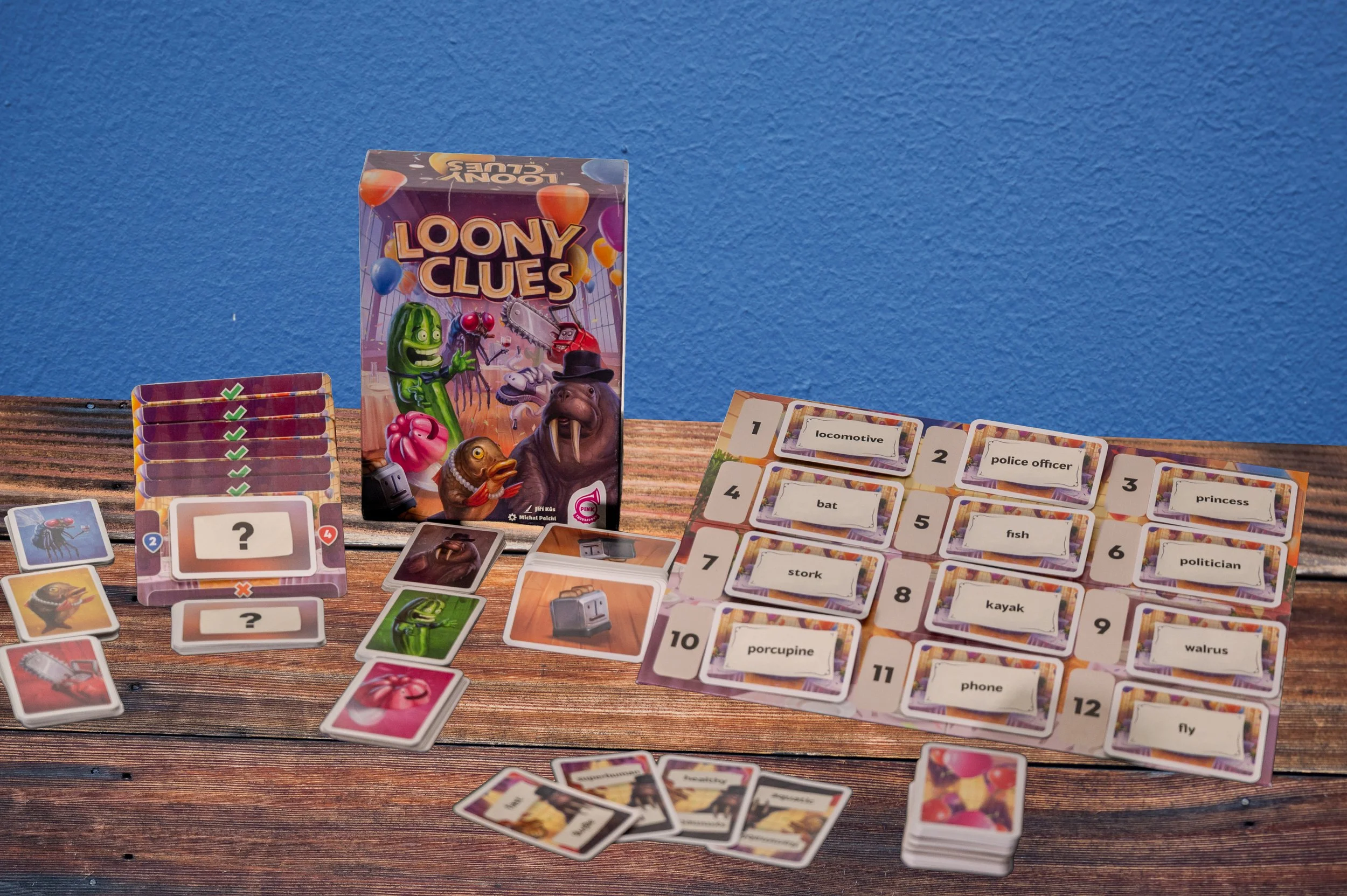
Why a party game? Because I have found not everyone wants a strategy game all of the time. Much of my extended family has tried to play strategy games and they just don’t connect with them. A game like Loony Clues helps to connect with family and friends who have similar experiences.
Loony Clues is a lively party word game where players hide behind secret identities and try to guess who's who, designed by Michal Peichl.
I've been excited to talk about this one for a while. Loony Clues comes from Pink Troubadour Games, the Czech publisher behind titles like Galileo Galilei, and it's one of the games we're now bringing over to North America.
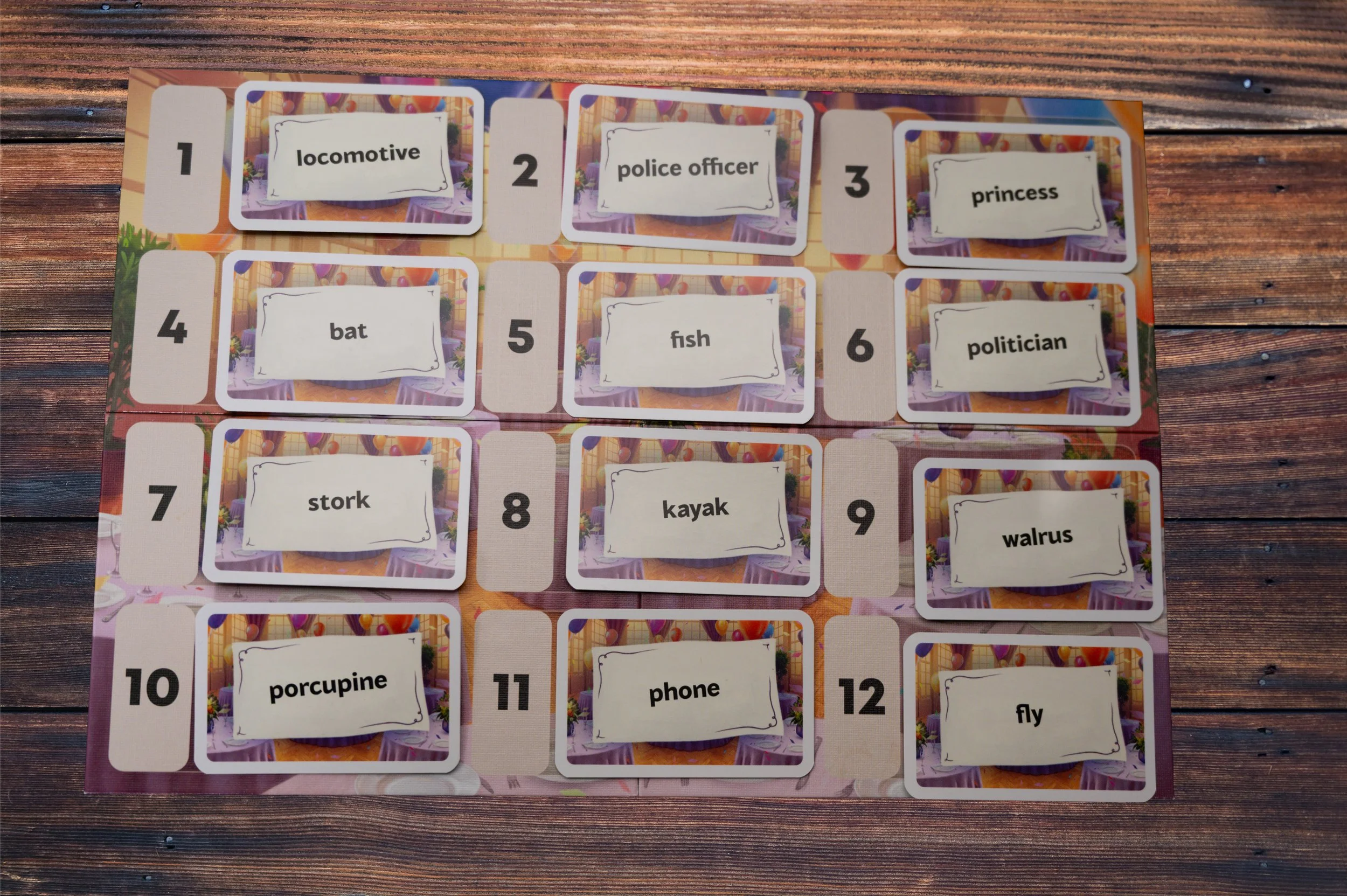
At the start of the game, players are randomly assigned one of twelve secret identities sitting on the board. From there, everyone takes turns asking each other yes-or-no questions off cards like "Are you colorful?" or "Are you flat?" in an attempt to figure out who everyone else is before they figure out you.
Here's what I love about it: there's no official definition of what counts as "flat" or "colorful." That's entirely up to the person answering. Is sushi washable? Depends who you ask, honestly. That ambiguity is the whole engine of the game. Every answer becomes a tiny negotiation between what's technically true and what feels true, and reading how someone else interprets a question ends up mattering as much as the question itself.
Scoring works both directions, too. You get points for correctly guessing who someone else is, but you also score when someone tries to guess you and gets it wrong. So there's a real push and pull to it. Do you answer straight and risk giving yourself away, or play it coy and hope nobody catches on? That tension is where most of the laughing at the table comes from.
Peichl's got a good track record for this kind of thing. He started out designing card games several years ago, and he also works as a graphic designer and illustrator on the side, so he's got an eye for what makes a game feel good on the table, not just play well.
We're bringing Loony Clues to North America as part of our new partnership with Pink Troubadour, alongside Pilgrims: Curious Adventures, Movie Fight, and Dirt & Glory. It's exactly the kind of bridge game I look for, light enough to teach in two minutes at a party, but with enough interpretive chaos that it holds up with a table of hobby gamers too.
Loony Clues is set to hit the States in October, and it'll retail at $24.99. Great price point for a party game you're going to want to bring to every game night from here on out.
More to come as we get further into bringing this one stateside. Just know that somewhere out there, someone is very confidently telling their friends that a pineapple is round.
Loony Clues
Designed by Michal Peichl
Published by Pink Troubadour Games (North American release via Valor Mountain Games)
$24.99 | October 2026
Coming Soon!
New games coming soon!
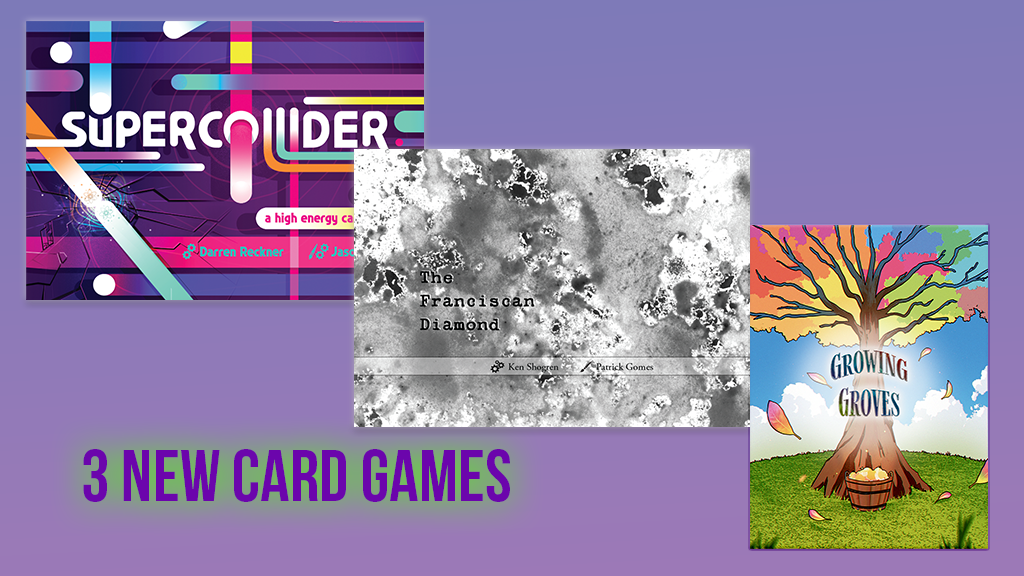
We have 3 trick taking games coming to Kickstarter soon. We are currently seeking production quotes from China. *Please note that none of this art is final and is in process as we prepare for the Kickstarter.
These are great games with interesting twists:
Supercollider
A trick taking game by Darren Reckner and Jason Hager. 2-4 Players.
Gain points by winning tricks in different suits. Blow up the same number and use modifiers.
54 cards, rulebook, and box.
BGG link coming soon.
The Franciscan Diamond
A noir trick taking game by Ken Shogren with deduction and 3 different modes of play.
18 cards, rulebook, scorepad, pencils, and box.
Growing Groves
A trick taking game of growing your fantastical trees and fruit by Chris Lawrence for 2-4 players.
73 cards (64 fruit cards, 5 silver cards, 4 treetop cards), rule
BGG link coming soon.